
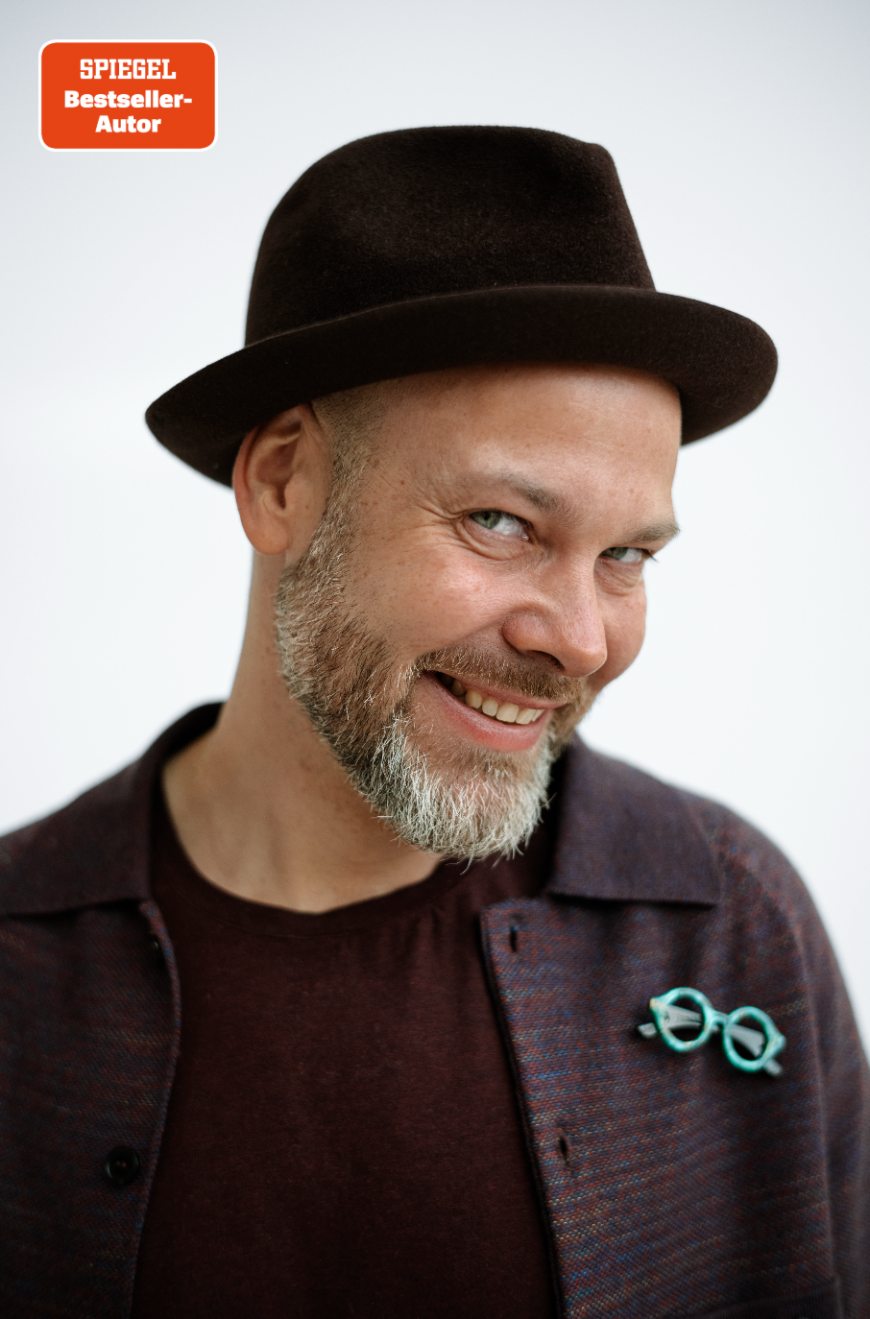
Christian Wehner is Senior Director Innovation Strategy at SAP and one of the leading voices on creativity and innovation in the corporate world. In his role, he develops visionary strategies, translates innovation processes into clear, accessible messages and helps clients unlock new ways of thinking and new business models.
His career path is remarkable: at 15, he left secondary school without any qualifications. Nevertheless, he worked his way up step by step into leadership positions at international brands – including several radio stations, Red Bull's media business and, in 2016, one of Germany's three fastest-growing tech start-ups – before moving to SAP.
Today, Christian Wehner is a sought-after keynote speaker, a guest lecturer at EBS Oestrich-Winkel x Markenakademie and the first German ambassador of the “School of Future Skills”, which is supported by Nobel Peace Prize laureate Muhammad Yunus. His book, a SPIEGEL bestseller, has been published in German.
How did you become the person you are today?
I've taken a very unconventional path – shaped by rebellion, curiosity and constant learning. Thanks to a certain carefree attitude, I often said “yes, and” instead of “yes, but”. That allowed me to hold on to my childlike naivety and openness. Looking back, that was exactly my greatest asset.
Why didn't you finish school?
I genuinely didn't manage to get my school-leaving certificate – I actually failed the exam twice. That had less to do with a lack of intelligence than with the fact that I simply didn't fit into the school system. Family turbulence, such as my parents' divorce, a rebellious phase and even detentions for cannabis made things even harder.
At 16, I had no qualifications and no apprenticeship – until, with a lot of luck, I ended up on a support programme that got me an unpaid six-month internship at OBI, the German DIY chain. I threw myself into it completely – and was then allowed to start an apprenticeship as a retail salesman.
Suddenly, everything clicked: at vocational school I got top marks and was even elected student representative. In that moment, I realised that practical opportunities and personal initiative can often achieve more than a rigid system that had previously written you off.
How did you get from OBI to SAP – without a traditional degree?
After my apprenticeship at OBI, I went straight into radio: first as a media consultant at Funkhaus Bamberg, later at Radio Arabella. There I looked after clients, planned events and developed sales strategies – pure hands-on experience that sharpened my talent for sales.
Through Erik Sacra (Partner at VESTIGA Consulting), I then joined Red Bull Media House, where, as Account Manager Sales Germany, I helped build up the media business and learned to think globally.
In 2012 I moved to Ryte (then OnPage.org), a bootstrapped tech start-up, first in business development and later as Senior Manager. As one of the first ten employees, I experienced first-hand its rapid growth into Germany's third-fastest-growing tech company.
In 2016 I finally joined SAP – first as Senior Solution Sales Executive, then in business development, and since 2020 as Senior Director Innovation Strategy. Today I shape strategies there around creativity, innovation and future skills.
At the start, nobody could have predicted your career. How relaxed were your parents about it – and what are you like as a father today?
My parents were surprisingly relaxed during my wild phase. Above all, though, they never gave up on me. Thanks to their support, I eventually got onto the programme that made the OBI internship possible.
As a father, I'm deliberately more laid-back today. After all, I preach seeing the world through a child's eyes and putting curiosity ahead of pure pressure to perform. My children should be allowed to try things out, fail and learn – without the pressure I felt back then. Because I know: creativity and courage open doors that grades often keep shut.
Your book became a SPIEGEL bestseller last year. What made you write it?
I see how many adults – including my former self – have lost their childhood superpowers: courage, curiosity, free play. Blocked by overthinking, perfectionism and fear of AI in a world that values performance above all else.
My own story shows that these very abilities are enough for everything that really matters. My keynotes and LinkedIn posts kept prompting questions like: “How did you manage that without any qualifications?”
So, together with the publisher Deutscher Wirtschaftsbuch Verlag, I brought together personal anecdotes, scientific findings and practical exercises. The book is an invitation to marvel at the world again through a child's eyes – and to be allowed to fail, without resentment. Especially at a time when AI replicates so much, it is about what makes us irreplaceable: adaptive intelligence, empathy and playful creativity.
What is the central message of your book?
The core message is simple: as a child, you were brave, curious and free. You asked questions without fear, built things and knocked them down, played and argued – without holding a grudge.
Everything you need for life, you learned back then. But growing up has pushed these abilities aside through overthinking, people pleasing, perfectionism and pressure to perform. In the age of AI, it's about reclaiming exactly these human superpowers.
What makes us humans irreplaceable in the age of AI?
Our childlike creativity: adaptive intelligence, genuine empathy, creative chaos and the ability to deal with uncertainty.
AI excels at data and patterns – but it doesn't invent genuine paradigm shifts, it doesn't sense group dynamics and it doesn't inspire through authentic humanity. We become irreplaceable when we let go of overthinking and, like children, start building, knocking down and starting over again. That's exactly where innovation happens.
Why do children in kindergarten learn faster and more lastingly than adults?
A child's brain is far more plastic, fluid intelligence is higher and neural connections form incredibly fast. Children live in the moment and don't just learn with a specific goal in mind – they take in the entire context, including seemingly irrelevant stimuli.
Adults, by contrast, filter heavily and learn in a more intellectual, slower way, held back by doubts and strategies. For children, failure is a game and repetition is fun, not a chore. It is precisely this state that we lose through pressure to perform – and it is precisely this that I write against.
How can we overcome overthinking, people pleasing and fear of AI?
By reactivating our childlike freedom: bold action instead of endless analysis, clear boundaries instead of people pleasing, and playful curiosity instead of fear.
Science shows that we never pressed the “unsubscribe” button on our childhood – it's all still inside us. It doesn't have to be extreme dares. Small dopamine kicks are often enough: a drive without satnav, a game of knock-down ginger or a friendly note left in a library book.
I break the habit of people pleasing with clear boundaries – just like in the sandpit. Children say “no” consistently, without feeling guilty.
And AI? I approach it the way a child approaches a new toy: playfully, experimentally, curiously. I use it regularly so I understand that it complements my creativity rather than replacing it. Who wants to end up like their own dad who can't work WhatsApp? 😉